









A kitchen renovation can include units, worktops and appliances, but it can also bring fitting, plumbing, electrics, flooring, lighting, decorating, waste, delivery, small parts and contingency into the same project. The balance changes with the budget.
These are planning bands, not quotes. The size and condition of your kitchen, where you live, how much work the room needs and the suppliers you choose can move the final figure substantially. Use this guide to choose the budget route closest to your project, then go deeper into the full end-to-end version.
Quick answer
There is no single price for a UK kitchen renovation. A useful way to start is to think about the project in three broad bands.
£5,000–£15,000
A tightly controlled renovation or substantial refresh. Keeping the existing layout, retaining usable items and choosing value-led products can be important.
Explore the £5,000–£15,000 kitchen renovation£15,000–£30,000
A more complete renovation with greater freedom around cabinetry, appliances, worktops, lighting and finishes.
Explore the £15,000–£30,000 kitchen renovation£30,000–£60,000+
A higher-specification renovation which may include premium or bespoke products, specialist suppliers, more extensive service changes or a managed showroom route.
Explore the £30,000–£60,000+ kitchen renovationThe numbers are only a starting point. A small £20,000 kitchen and a large £20,000 kitchen can involve very different choices.
Does your project alter the building?
Extensions, structural openings, substantial service moves and similar work can sit outside a conventional kitchen renovation budget. They can also change which planning band is realistic. Keep kitchen supply and installation separate from building work from the first day.
Which budget guide should I read?
Choose the page that most closely matches the total amount you are trying to control, rather than the price of the kitchen units alone. That distinction matters. A £12,000 cabinet quote is not the same thing as a £12,000 renovation.
Ask whether your number also needs to cover:
- 01worktops
- 02appliances
- 03sink and tap
- 04installation
- 05electrician
- 06plumber
- 07gas work where applicable
- 08extraction
- 09lighting
- 10flooring
- 11splashback
- 12painting
- 13waste removal
- 14delivery
- 15small finishing items
- 16contingency
If several of those costs still sit outside the number you have in mind, move up a band or use the Kitchen Cost Estimator to build a fuller planning range.
Planning bands, not a national price list
Pocketa uses three UK planning bands so a homeowner can choose a route: £5,000 to £15,000, £15,000 to £30,000, and £30,000 to £60,000+. They are orientation for what a total project might need to cover, not a quotation and not a promise of what any supplier will charge.
Room size, specification, location, existing condition, layout changes, labour and building work can move the same kitchen into a different band. A compact galley and a large open-plan room with the same headline figure are not the same project. Use the Kitchen Cost Estimator when you want a range from your answers.
Published UK renovation cost guides describe a similar spread from tightly controlled work through more complete and higher-specification projects. See, for example, Checkatrade's kitchen renovation cost guide. Last reviewed August 2026.
What every kitchen budget needs to cover
The proportions change, but most full kitchen projects contain four groups of spending.
The kitchen itself
- carcases, doors, drawers, end panels, plinths and fillers
- cornice or trim where relevant
- internal storage
- handles or handleless components
- worktops and upstands
Products around the kitchen
- oven, hob, extractor, fridge or fridge freezer, dishwasher
- washing machine where housed in the kitchen
- sink, tap, lighting, flooring, splashback
- switches and sockets, water filtration, bins and organisers
People and installation
- kitchen designer, kitchen fitter, builder
- electrician, plumber, Gas Safe registered engineer where gas work applies
- flooring installer, decorator, worktop templater and installer
- plasterer, waste collection
The things that are easy to forget
This is often where an apparently complete budget starts to drift. Small lines may include delivery, collection, disposal, parking, extra sockets, pipework changes, appliance connection, trim, sealant, adhesives, grout, thresholds, replacement skirting, touch-up paint, temporary cooking arrangements and remedial work discovered after strip-out.
Keep a contingency rather than assuming every unknown will resolve at zero cost. The Cost Organiser can help keep planned and recorded amounts visible separately.
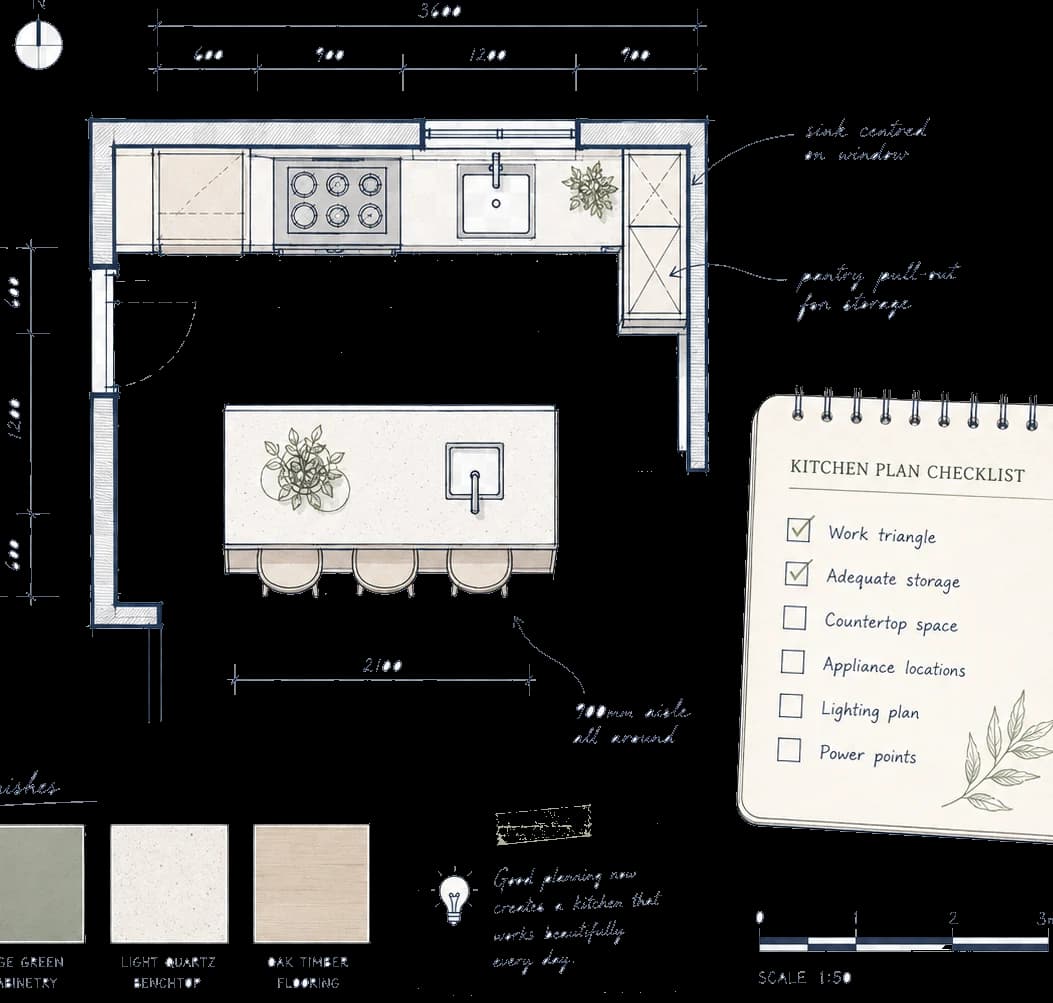
Strongest decision: what you choose not to change.
£5,000–£15,000: control the scope
At this level, the strongest budget decision may be what you choose not to change. A project towards the lower end might be a significant refresh rather than a completely new kitchen. Towards £15,000, a smaller or straightforward kitchen may be able to replace much more, particularly where the existing layout and services stay broadly where they are.
- retaining the current layout
- keeping usable appliances
- using standard-size cabinetry
- choosing value-led doors and worktops
- keeping the existing floor if sound
- limiting new electrical points
- avoiding structural work
- sourcing selected products yourself
- carrying out non-technical finishing jobs yourself where appropriate
The biggest risk is trying to fit a £20,000 scope into a £10,000 budget by under-allowing for fitting and services.
See the complete £5,000–£15,000 renovation route
Spend deliberately around the things that matter most.
£15,000–£30,000: replace more of the room
This band can give the project more flexibility. A homeowner may be able to combine new cabinetry, new worktops, a more complete appliance package, new sink and tap, professional installation, flooring, wall finishes, layered lighting and selected electrical or plumbing changes.
There is also more room to decide where to spend and where to keep things simple. You might use standard cabinetry but spend more on worktops and appliances. Or you may prioritise cabinetry and storage while choosing more modest appliances. The goal is not to make every category “mid-range”. It is to spend deliberately around the things that matter most to the household.
See the complete £15,000–£30,000 renovation route
A different approach, not only more expensive versions of the same products.
£30,000–£60,000+: expand the specification
At £30,000 and above, the project can begin to support a different approach rather than simply more expensive versions of the same products. Possible additions include premium or bespoke cabinetry, specialist storage, stone or other premium worktops, higher-spec integrated appliances, a large island, specialist extraction, architectural lighting, premium taps and sinks, custom joinery, flooring through adjoining spaces, more extensive service changes, project management, design fees and building work.
There are two valid ways to organise this. One is to appoint a premium kitchen studio or specialist supplier to take responsibility for much of the design, supply and installation. The other is to assemble the project from separate specialists. Neither route is automatically better.
See the complete £30,000–£60,000+ renovation routeWhat changes most between the budgets?
Layout freedom
Moving the sink, cooking zone, radiator, doorways or major services can increase the work before the kitchen is even fitted. Lower-budget projects tend to benefit more from keeping the existing arrangement. Higher budgets can absorb more change, although every change should still have a purpose.
Cabinetry, worktops and appliances
Standard modular cabinetry and value-led surfaces can keep costs controlled. Higher budgets may open more door finishes, customised dimensions, specialist fabrication or fully bespoke joinery. Keeping functioning appliances can materially change a lower-budget renovation; at higher levels, appliance packages can become one of the largest parts of the project.
Labour, coordination and details
A lower product spend does not remove the need for competent fitting or regulated work. Higher-budget projects may also add design fees, project management and more specialist installers. Lighting, handles, sockets, internal storage, taps and surface finishes may look individually small compared with the cabinetry quote. Together, they can change both the final room and the final spend.
Who might you need to deal with?
Not every kitchen needs every specialist. A straightforward like-for-like renovation might involve a kitchen retailer or supplier, kitchen fitter, electrician, plumber, worktop supplier or templater, appliance retailer and flooring or wall-finish supplier.
A more complicated project might add a kitchen designer, builder, structural engineer, architect or architectural designer, plasterer, decorator, specialist lighting supplier or bespoke joiner. The important point is that the kitchen quote may only represent one part of that list.
See also the Kitchen Renovation Planner and Kitchen Renovation Checklist.
Where Pocketa partners fit
Pocketa has retail partners across many of the products that sit around a kitchen renovation. That can include appliances, lighting, tools, hardware, flooring, splashbacks, paint, filtration, kitchenware and items for the finished room.
The partner route should sit beside the project rather than dictate it. When a relevant Pocketa partner exists, you can compare that route. When another retailer, local supplier, showroom or trade is better for your project, use them instead and keep the purchase in the same project record.
On the detailed budget pages, partner options appear as carousels at the moment you would normally make that type of buying decision. Eligible partners are limited to retailers relevant to the product or project stage. Commercial terms may influence the order of those eligible options. You remain free to compare prices, choose another partner or buy elsewhere. Read Why Pocketa is free for the full model.
What commonly pushes the budget higher?
- Changing the layout. Service moves often affect more than one trade.
- Structural work. Removing walls, changing openings or altering the building is a different proposition from replacing cabinets.
- Premium appliances. An appliance package can move several thousand pounds in either direction.
- Worktop fabrication. Templating, cut-outs, upstands, waterfall ends and installation all matter.
- Bigger rooms. More cabinets normally mean more doors, panels, worktop, flooring, lighting and fitting.
- Hidden problems. Old wiring, damaged floors, plumbing issues or poor walls may only become obvious once the existing kitchen comes out.
- Late changes. Specification changes after ordering can be expensive once cabinetry, worktops or made-to-order pieces are in production.
In higher-cost areas such as London, labour and access can also move the same specification into a higher planning band. Confirm local quotations rather than treating a national planning figure as a fixed total.

Keeping the difference is a perfectly good outcome.
What could you buy if there is money left?
Finishing below the maximum budget does not mean you need to spend the difference. Keeping it is a perfectly good outcome.
If the core renovation is already covered, optional areas might include better internal storage, improved lighting, a better tap, water filtration, a small appliance you will genuinely use, cookware, coffee equipment, dining furniture, window treatments, storage for adjoining spaces, or outdoor cooking if the kitchen opens onto the garden. Treat these as optional purchases after the essential renovation is secure.
Practical boundary
Regulations vary across the UK. Check the requirements that apply in England, Wales, Scotland or Northern Ireland, and to your specific property and project.
Frequently asked questions
Is £10,000 enough to renovate a kitchen?
It can be enough for some kitchens, particularly where the room is smaller, the layout stays similar and some existing items are retained. A complete replacement involving extensive service moves, premium products or substantial building work may require more.
Is £20,000 a good kitchen renovation budget?
£20,000 can support a fairly complete renovation in many situations, but room size, appliances, cabinetry, worktops and labour can move the result considerably. Treat the number as a total project budget rather than only the kitchen-unit allowance.
What does a £30,000 kitchen renovation include?
It could include new cabinetry, worktops, appliances, professional fitting, services and room finishes, with more flexibility around specification. It could also disappear quickly in a large room or where building work and premium products are involved.
Can a kitchen renovation cost more than £60,000?
Yes. Bespoke cabinetry, premium appliances, specialist stone, architectural changes and extensive building work can take a project significantly above £60,000.
Should appliances be included in my kitchen budget?
If you intend to replace them, yes. Keeping the appliance budget separate from the cabinetry quote makes the total project picture easier to understand.
How much contingency should I keep?
There is no single percentage that suits every project. The less you know about the property condition or scope, the more important it is to leave room for uncertainty rather than allocating every pound before work begins.
Related: What products do you need? · Complete planning guide · How Pocketa works